
The term “metal fabrication” refers to the processes used to create a finished part or product by shaping, adding, or removing material from a raw or semi-finished metal workpiece. The following article provides an overview of the types of fabrication processes available, outlining what they entail, what materials they accommodate, and what applications for which they are suited.
Cutting
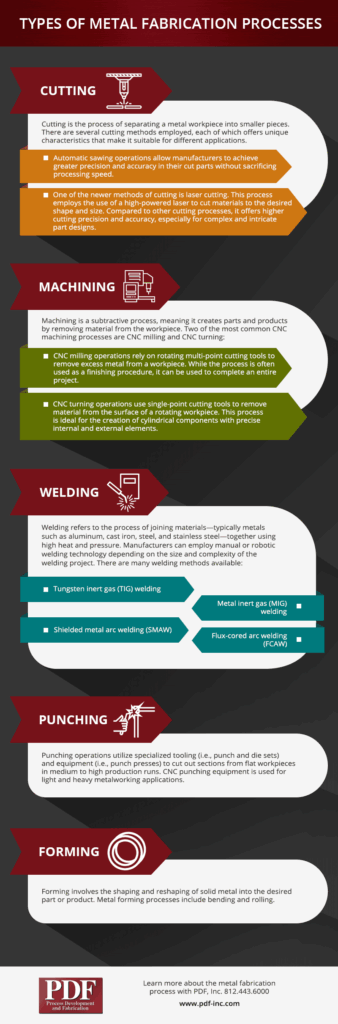
Cutting is the process of separating a metal workpiece into smaller pieces. There are several cutting methods employed, each of which offers unique characteristics that make it suitable for different applications.
The oldest method of cutting is sawing. This process utilizes cutting blades—either straight or rotary—to cut materials into different sizes and shapes. Automatic sawing operations allow manufacturers to achieve greater precision and accuracy in their cut parts without sacrificing processing speed.
One of the newer methods of cutting is laser cutting. This process employs the use of a high-powered laser to cut materials to the desired shape and size. Compared to other cutting processes, it offers higher cutting precision and accuracy, especially for complex and intricate part designs.
Machining
Machining is a subtractive process, meaning it creates parts and products by removing material from the workpiece. While some manufacturers continue to use manual machining technologies, many are turning to computer-controlled machining equipment, which offers tighter tolerances, greater consistency, and faster processing speed.
Two of the most common CNC machining processes are CNC milling and CNC turning. CNC milling operations rely on rotating multi-point cutting tools to remove excess metal from a workpiece. While the process is often used as a finishing procedure, it can be used to complete an entire project. CNC turning operations use single-point cutting tools to remove material from the surface of a rotating workpiece. This process is ideal for the creation of cylindrical components with precise internal and external elements.
Welding
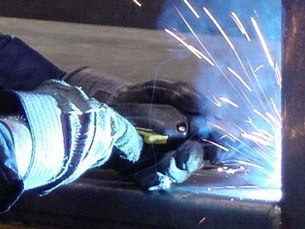
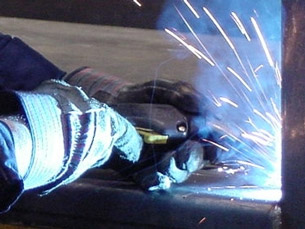
Welding refers to the process of joining materials—typically metals such as aluminum, cast iron, steel, and stainless steel—together using high heat and pressure. There are many welding methods available—including tungsten inert gas (TIG) welding, metal inert gas (MIG) welding, shielded metal arc welding (SMAW), and flux-cored arc welding (FCAW)—all of which entail different welding materials and skill requirements. Manufacturers can employ the resources of a manual or robotic welding company depending on the size and complexity of the welding project.
Punching
Punching operations utilize specialized tooling (i.e., punch and die sets) and equipment (i.e., punch presses) to cut out sections from flat workpieces in medium to high production runs. CNC punching equipment is used for light and heavy metalworking applications.
Forming
Forming involves the shaping and reshaping of solid metal into the desired part or product. There are several different forming processes available, including bending, drawing, extrusion, forging, pulling, rolling, and stretching. They are commonly used with sheets and plates—as well as other material forms—to produce simple components to complex assemblies.
Partner With the Experts at PDF, Inc. for Your Metal Fabrication Needs
Metal fabrication encompasses a wide range of processes, including, but not limited to, cutting, machining, welding, punching, shearing, and forming. While most metal fabrication shops do not offer all of these processes in-house, at PDF, Inc., we provide all of these capabilities and more under a single roof. For additional information about our metal fabrication services, contact us or request a quote today.
Leave a Reply